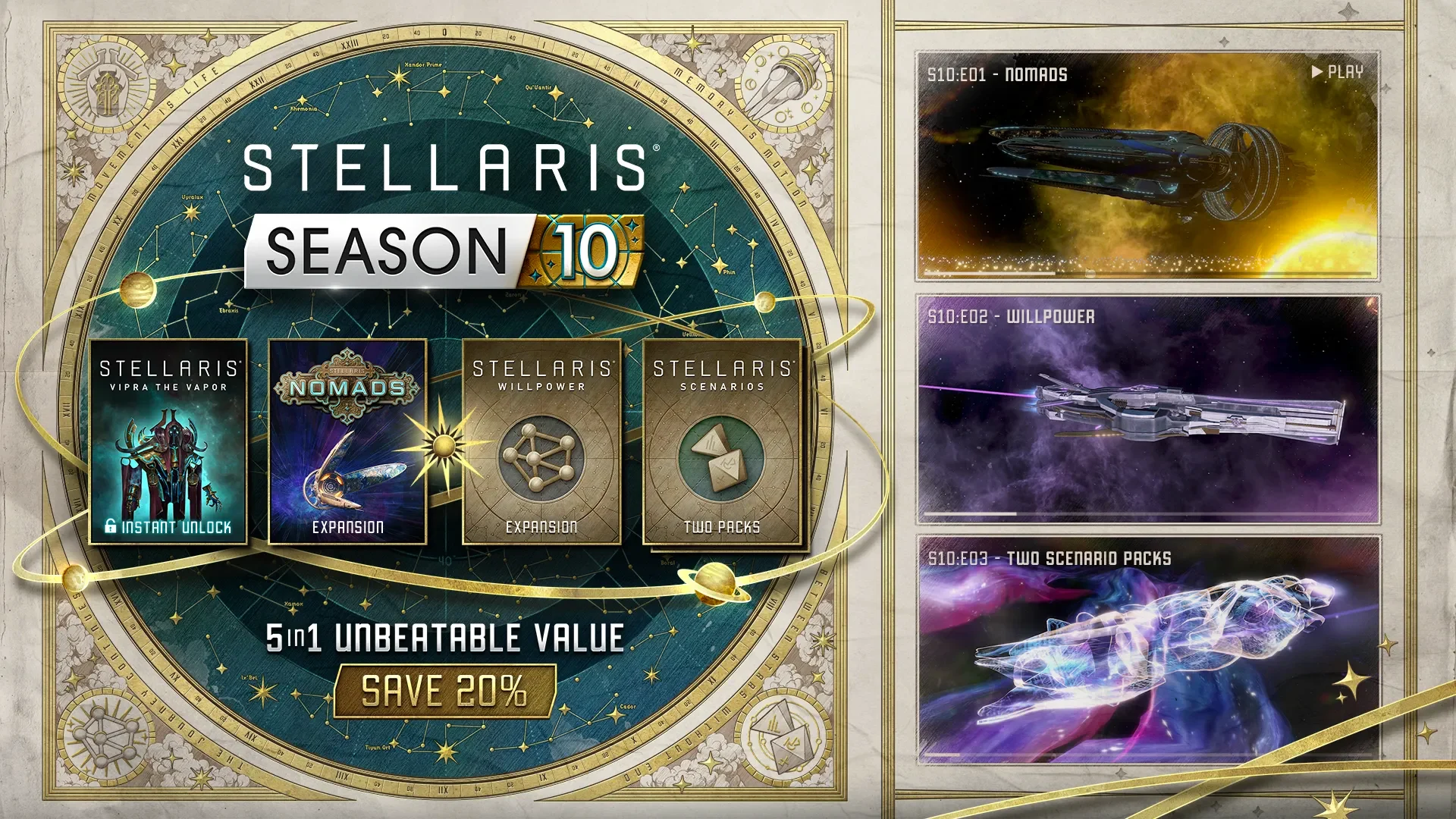
Stellaris Season 10 launched on 30 April 2026, bundling four 2026 DLCs and a cosmetic species pack into a single expansion pass for $49.49. Day-one buyers get the Vipra portrait; everything else, including the Nomads expansion in Q2 and the Willpower systems DLC in Q4, is a promise. The pitch is good. The track record is mixed.
Paradox Interactive launched the Stellaris Season 10 expansion pass on 30 April 2026, alongside the free 4.3.5 patch. The pass is the publisher’s way of selling the entire 2026 roadmap up front: $49.49 / £41.59 / €49.49 buys you four DLCs as they land throughout the year, plus immediate access to the Vipra Vapor Species Portrait. Paradox claims a 20% saving compared to buying the packs separately. That is the official copy. The unofficial copy is more interesting.
What you actually get on day one
Not a lot. The Vipra portrait is the only tangible content unlocked at launch: an ethereal Necroid-style species with five phenotypes and custom animations. Cosmetic. Nice to have. Not the reason anyone is buying a season pass.
The real content sits on the calendar: Nomads in Q2 2026, Willpower in Q4 2026, and two Scenario Packs also in Q4. Patch 4.4 “Pegasus” arrives with Nomads. Patch 4.5 “Cygnus” lands mid-year as a Custodian update. Patch 4.6 “Corona Borealis” closes the year alongside Willpower and the scenarios. There is also creator-confirmed reporting that Utopia, Synthetic Dawn, and Humanoids will fold into the base game at the start of the season, which would be the most quietly significant change of the bunch – older paid content becoming free as the new paid content gets sold up front. Paradox has not foregrounded this in marketing copy, so it is worth treating as expected rather than confirmed until the official patch notes land.
Nomads is the actual pitch
This is the part of Season 10 worth caring about. Nomads lets you play Stellaris without planets, building colossal Arkships that carry your civilization across the galaxy. Waystations link your routes into trade and influence networks. The four announced Origins – Voidfarers, Heirs of the Khan, The Sacred Path, and Forever Cruise read like four genuinely different fantasies rather than four flavors of the same thing. A new Ambition called Defender of the Galaxy promises hero ships and a defensive endgame role. There is also a megastructure called the Stellar Cannon, which sounds like it does what you would expect a megastructure called the Stellar Cannon to do.
This is the kind of design swing the community has been asking Paradox for. Stellaris empires have always been about borders, choke points, and tall versus wide; Nomads inverts every one of those assumptions. If it lands, it is a genuinely new way to play. If it does not, it will be a curiosity bolted onto the side of the existing systems, the way some Stellaris DLC ends up.
Willpower is a Q4 promise
Willpower is positioned as the ideological counterpart to Nomads: ethics evolving into proper ideologies that shape empire behaviour, with new origins, fanatic civics, an Ethical Ambition called Force of Will, and customizable megastructures. The marketing language hints at internal politics that could finally function as a soft crisis layer – revolts, ideological blocs, empires that fracture from inside rather than from a scripted endgame. Players have been asking for that for years.
The catch is that Willpower is six months away as of writing, and “ethics become powerful ideologies” is exactly the kind of phrase Paradox has used before to describe DLCs that ended up being modifier-flavored rather than mechanically meaningful. Buying Season 10 today means buying Willpower based on a sentence.
About that track record
I have been playing Stellaris since launch and put hundreds of hours into it on YouTube, mostly running mods like Star Trek: New Horizons. The modders are why I have stayed loyal as long as I have, because they consistently outdo what Paradox itself ships. I have been off the bandwagon for a while now, and Season 10 is the first time in a while I have looked at a Stellaris announcement and thought, maybe.
Maybe is doing a lot of work in that sentence. Paradox’s release record across Stellaris, Crusader Kings, Hearts of Iron, Europa Universalis, and the rest is famously inconsistent. About a third of what they ship lands. The other two-thirds get mixed Steam reviews, underwhelming expansions, and the kind of community frustration that builds over years. Europa Universalis V is sitting on Mostly Positive with around 12,000 reviews as of 30 April 2026, and Stellaris’s recent expansion track has not been a clean run either. The strange thing is that Paradox knows exactly what its audience wants. The community tells them, repeatedly, in detail. And the company still ships hits and misses in roughly the same ratio it has for a decade. Their consistency is their inconsistency.
So should you buy Season 10
No. Or at least, not yet.
I am trying to love Paradox. They are making it hard. Buying Season 10 on 30 April means paying $49.49 for one cosmetic portrait, a Q2 expansion that looks promising on paper, and a Q4 systems DLC plus two scenario packs that are currently single sentences in marketing copy. That is the proverbial cat in the sack. Wait for Nomads to actually launch in Q2. Read the dev diaries. See whether the Origins play differently or whether they are reskins of each other. See whether ARkships scale or stagnate. If Nomads delivers, the Season 10 pass will still be there to buy, and you will know what you are paying for.
If you are the kind of player who buys every Paradox pass on principle and trusts the studio to land more often than it misses, you have already clicked the button by the time you have finished reading this paragraph. You do not need this article. Everyone else: wait.
The Steam page for Season 10 also discloses that Paradox “employ generative AI technologies during the creation of some assets,” specifically for ideation and visual reference material. That will matter to some buyers and not to others. It is worth noting it is there.
