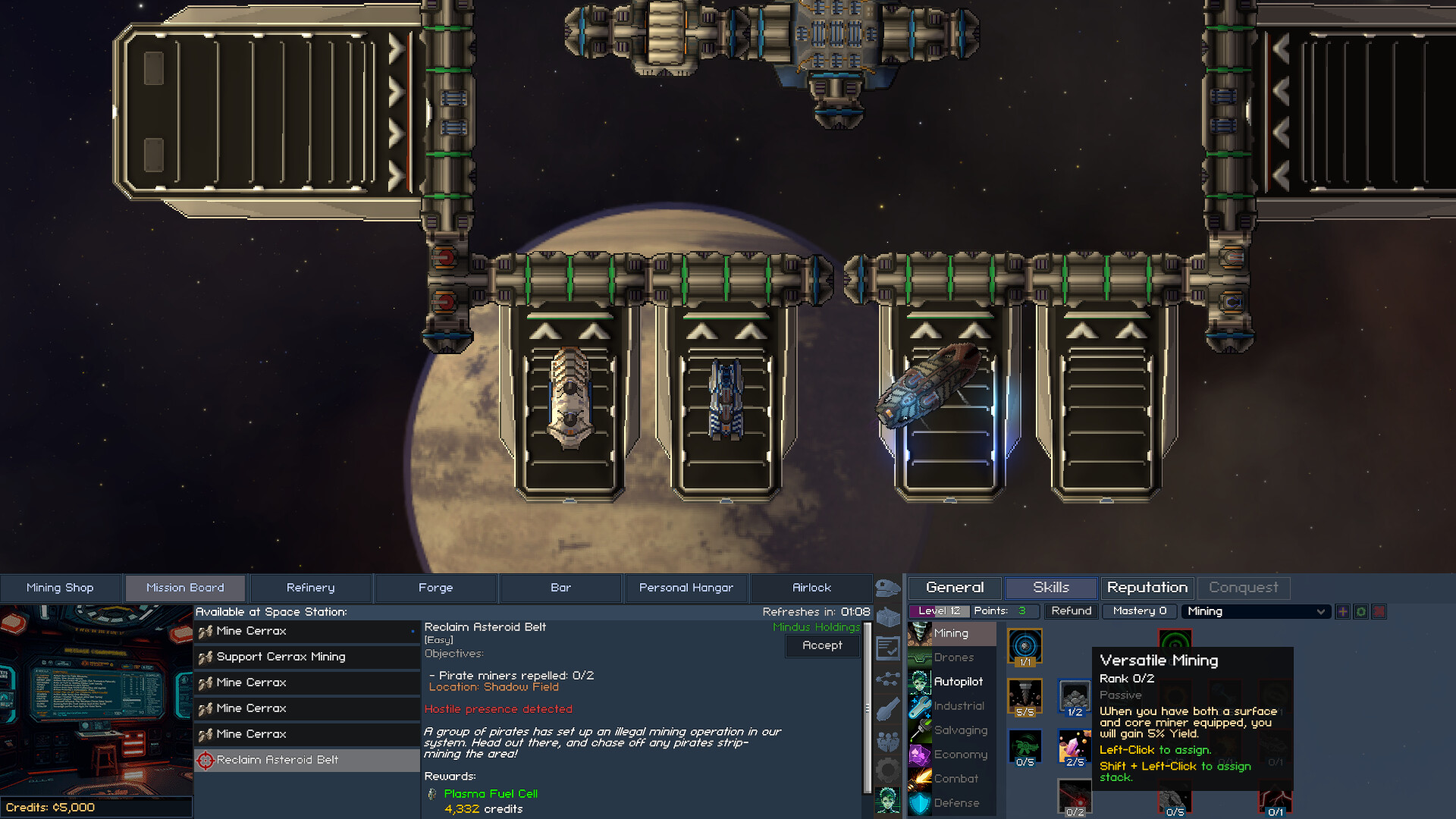
Vanguard Galaxy | Developer & Publisher: Bat Roost Games | Early Access since October 30, 2025 | $8.99 on Steam
I started playing EVE Online around 2005. If you know EVE, you know it’s not a game that asks nicely for your time; it takes it. Ships you lose are gone for good, financial loss is real and insurance barely covers the hull and none of the modules, which can cost ten times more than the ship itself. Even high-security space does not guarantee you will be safe if you run into a very committed ganker. It’s brutal game, unlike anything else out there.
One of the things I actually enjoyed in EVE was running multiple accounts, setting up three or four mining barges, hauling ore while I worked or watched a show. Multiboxing, they called it. Not everyone was a fan of this practice. Other players would run suicide attacks to blow up semi-AFK miners even in protected space. But the truth be told I never met anyone who enjoyed watching a laser slowly chew through a rock with zero interaction from you. Mining was mostly something that you did alongside something else you did.
So when I first heard that the semi-AFK autopilot is one of Vanguard Galaxy’s most praised features, I was genuinely curious, but laso a little skeptical. Could a game actually make that loop feel intentional rather than incidental?
After nearly 50 hours in the Canis Major dwarf galaxy, I have an answer.
It’s complicated.
What Vanguard Galaxy Actually Is
Bat Roost Games, both developer and publisher on this project, describes it as a relaxing space exploration game you can run in a window at the bottom of your screen while you work or watch something else. You trade, fight, mine, and salvage your way through a procedurally generated galaxy, with the option to engage an autopilot AI that handles most of the basic tasks on your ship’s behalf. At $8.99, the entry price isn’t the issue.
The core loop is straightforward: dock at stations, accept missions, do the mining or combat, whatever it is, and then come back complete the mission. Or, you can let your AI companion ECHO handle the grind. She’ll take mining contracts, salvage derelicts, complete delivery runs. The economy runs through a familiar track; collect blueprints, gather materials, refine them at a station refinery, craft gear at the forge, sell or equip. Station to station, system to system, through stargates. Traveling is not a huge issue. Most jumps take 10 to 30 seconds, a minute if you’re short on warp fuel.
It’s the kind of structure that’s easy to understand and easy to leave running.
The Autopilot Is Both the Point and the Problem
Here’s where it gets interesting. Vanguard Galaxy doesn’t pretend to be something it isn’t – it’s tagged as an Idler on Steam, and the store page openly advertises placing it at the bottom of your screen while you do other things. That’s not a bug, it’s the pitch and a feature.
But there’s a meaningful difference between a game that lets you automate and a game that’s worth experiencing when you do. Think of Distant Worlds 2 , a space 4X that can be set to run almost entirely on its own due to a very high amount of potential automation, where watching your empire build and expand is appealing. The AI doing things feels like your empire doing things, and you can always jump in and take over the reins if you want to.
Vanguard Galaxy doesn’t quite get there.
Of my nearly 50 hours in the game, I’d estimate two-thirds were played with ECHO (that is the name of the AI in the game) on autopilot while I was doing something else. It was not a huge issue for me to let go. The game was not that appealing to play anyway. The world is too sparse. Systems feel interchangeable. The static space backgrounds don’t help; there’s no sense of depth, no pull toward the horizon.
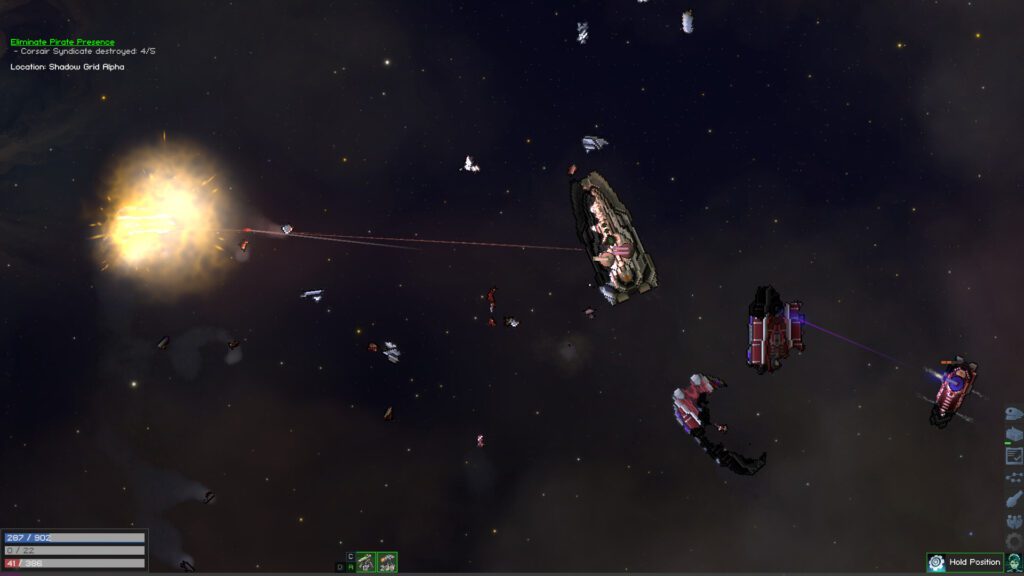
Combat is where this flatness hurts most. The outcome of any given fight is determined almost entirely by your module quality even before the first shot is fired. Your only real input is occasionally dodging a missile manually – maybe 1% of the fight, if that. There’s no tension in it, and no satisfaction when it’s over.
A Fair Comparison
If you’re drawn to this kind of indie space exploration, look at Starcom: Unknown Space by Wx3 Labs first. It’s a fully released action-adventure RPG with over a hundred star systems, a proper story, alien factions with real political dynamics, and a ship-building system that lets you actually design your vessel. It currently holds a Very Positive rating from over 3,900 Steam reviews. It delivers what Vanguard Galaxy is still building toward: a space that feels worth exploring, fights that require something from you, and reasons to care what happens next.
Starsector, the legendary and the long-running indie that still lives outside Steam at fractalsoftworks.com, is another benchmark for this genre. Both Starcom and Starsector demonstrate what depth looks like in indie space games, and that context matters when evaluating where Vanguard Galaxy currently sits.
The Honest Take
I want to be straight about something: I find it genuinely uncomfortable to be harsh on indie developers. The people who make these games are often doing it out of real passion, and the indie space has produced some of the most interesting games of the last decade. Bat Roost Games is clearly building something with intention; the developers have stated a roadmap of 6 months to a year in Early Access, with plans to flesh out the main gameplay loop and add more content. But right now I am not optimistic. It’s been almost six months since the release of the game even though it’s in early access and it has a much longer way to go than perhaps another six months or even a year to compete with heavy hitters like Starcom.
50 hours in, Vanguard Galaxy is too empty to recommend with confidence. The pacing is slow without the depth to justify the pace. The pixelated aesthetic doesn’t have the charm or visual coherence to compensate. You can multi-task while it runs, yes – but unlike the best idle-adjacent games, there’s not much pulling you back when you look up from whatever else you’re doing.
Should you play it right now? If semi-AFK space loops genuinely appeal to you and $8.99 is negligible, it might be worth it. But if you’re looking for a satisfying indie space experience today, Starcom: Unknown Space is the stronger choice by a significant margin.
Check back on Vanguard Galaxy in six months. The bones are there. The meat isn’t yet.
